
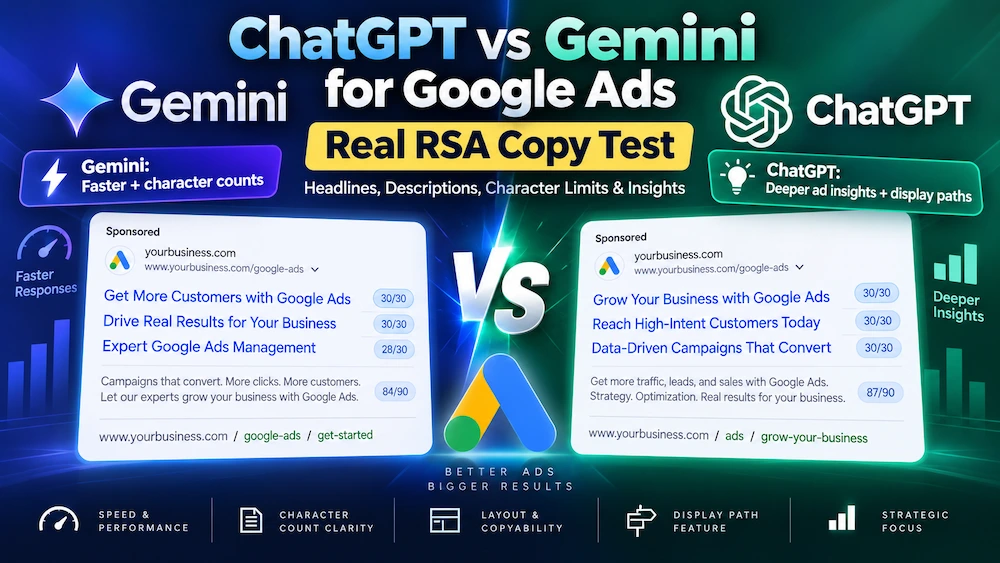
But when it comes specifically to writing Google Ads Responsive Search Ads (RSA), which AI does a better job: ChatGPT or Gemini?
Instead of comparing features on paper, I ran a simple side-by-side test using the same type of Google Ads copywriting task in both tools.
What I found was interesting. There was no clear winner overall. Gemini performed slightly better as a direct RSA copywriting tool, while ChatGPT went deeper into advertising strategy, messaging and improvement ideas.
What I Tested
For this comparison, I asked both AI tools to write high-conversion Google Responsive Search Ads for a dentist in Delhi with around 10 years of experience.
The objective of the campaign was to generate enquiries and clinic visits using search terms such as:
- Dentist in Delhi
- Dentist near me
- Best Dentist Delhi
I then compared both tools based on speed, headline quality, descriptions, character-limit visibility, ease of copying, display paths and the strategic insights provided with the ads.
ChatGPT vs Gemini for Google Ads: Quick Comparison
| Feature / Metric | Gemini | ChatGPT |
|---|---|---|
| Speed & Performance | Faster response time | Nearly the same speed, but slightly slower |
| Character Count Clarity | Automatically shows character lengths for headlines and descriptions | Uses more space but does not explicitly show character counts upfront |
| Layout & Copyability | Headlines are kept small and compact | Visually compact layout and easy to copy text or code blocks |
| Display Path Feature | Did not prominently suggest display paths in the initial output | Provided suggested display paths, which was a useful bonus |
| Strategic Focus | Stronger focus on campaign planning and structured execution | Deeper insights into ad refinement, messaging angles and new ideas |
1. Gemini Was Slightly Faster
The first difference I noticed was speed.
Gemini generated the ads slightly faster than ChatGPT. However, the difference was quite small and probably not significant enough to choose one AI tool over the other.
For everyday PPC work, I would consider both tools fast enough for generating Google Ads headlines and descriptions.
2. Gemini Did a Better Job of Showing Character Limits
This was probably the most useful advantage of Gemini in my test.
Gemini displayed the character count alongside the individual headlines and descriptions. For example, you could immediately see whether a headline was using 20, 25 or 30 characters.
This is particularly useful when writing Responsive Search Ads because Google Ads has specific character limits for RSA assets.
Instead of having to manually check whether each headline or description fits, Gemini makes this information immediately visible.
ChatGPT understood the Google Ads limits and created suitable copy, but its initial output did not clearly show the character count beside every headline.
For someone creating a large number of Google Ads, Gemini’s character-count presentation can save time.
3. Headline Quality Was Almost the Same
When comparing the actual headline ideas, I didn’t see a major difference between ChatGPT and Gemini.
Both were able to create different headline types covering:
- Main target keywords
- Location intent
- Experience and trust
- Benefits
- Calls to action
- Service-related messaging
Both tools produced headline ideas that could realistically be tested in a Google Ads campaign.
So based purely on Google Ads headline quality, I would consider them almost equal in this test.
4. Gemini’s Descriptions Had a Slight Edge
For descriptions, I personally preferred Gemini’s output slightly more.
The descriptions were concise, easy to understand and accompanied by visible character counts. This made them feel closer to a ready-to-use Google Ads format.
Again, ChatGPT’s descriptions were good, so the difference wasn’t dramatic.
But if I had to choose based only on generating RSA headlines and descriptions quickly, I would give Gemini a slight advantage.
5. ChatGPT Provided Display Path Suggestions
One useful detail in ChatGPT’s response was the inclusion of suggested display paths.
Display paths are a small part of the final Search ad, but they help make the advertisement more complete and can reinforce the service or location being advertised.
Gemini concentrated more heavily on the headlines and descriptions in its initial output, while ChatGPT provided a more complete RSA structure.
This was a small but useful advantage for ChatGPT.
6. ChatGPT Went Deeper Into the Advertising Strategy
This was the biggest difference between the two tools.
ChatGPT didn’t simply generate ad copy. It also started thinking about how the advertisement could be improved.
For example, one of the target keywords provided in the prompt was:
“Best Dentist Delhi”
ChatGPT highlighted that using a direct advertising claim such as “Best Dentist in Delhi” should be approached carefully unless that claim can be properly supported.
That is an important PPC distinction:
A keyword that someone searches for doesn’t necessarily have to be copied word-for-word into the advertisement.
This type of observation is where I found ChatGPT more useful.
It went beyond writing ads and started exploring areas such as:
- Alternative messaging angles
- Trust signals
- Stronger calls to action
- Different user intentions
- Potential advertising claims
- Unique selling propositions
- Landing page messaging
- Ways of improving overall campaign performance
For an experienced PPC professional, these additional ideas can sometimes be more valuable than simply receiving another set of 15 headlines.
7. Gemini Appears More Focused on Campaign Planning
My comparison was mainly focused on Google Ads copywriting, but after using both AI tools I noticed another broader difference.
Gemini often takes a more structured campaign-planning approach.
Its responses tend to be organized around the campaign, ad groups, headlines, descriptions and execution.
This can be useful when you want AI to quickly organize a Google Ads campaign and produce structured assets.
8. ChatGPT Appears Better at Exploring New Ideas
ChatGPT, on the other hand, tends to explore the question more deeply.
Instead of only answering “What ads should I write?”, it often starts exploring:
- Why would someone click this ad?
- What is missing from the offer?
- What other messaging angle could be tested?
- What objections might a potential customer have?
- How could the landing page support the ad?
- What could make this campaign different from competitors?
That makes ChatGPT particularly useful during the strategy and brainstorming stage of PPC campaign creation.
Gemini vs ChatGPT: Which Is Better for Google Ads Copywriting?
Based on my test, I would summarize the difference like this:
Gemini was slightly better at producing ready-to-use headlines and descriptions, while ChatGPT was better at generating deeper advertising insights and new ideas.
Gemini’s advantages were:
- Faster output
- Visible headline character counts
- Visible description character counts
- Concise headline presentation
- Good structured campaign planning
ChatGPT’s advantages were:
- Easy-to-copy output
- Display path recommendations
- Deeper advertising insights
- More messaging ideas
- Better brainstorming around opportunities
- More discussion around how the ad itself could be improved
Why I Would Use Both ChatGPT and Gemini
I don’t think PPC professionals need to choose only one AI tool.
Google Ads recommends using multiple high-quality Responsive Search Ads in an ad group, which gives advertisers an opportunity to test different messaging approaches.
Instead of debating:
“Should I use ChatGPT or Gemini?”
A more practical approach could be:
“Why not generate ideas from both and let the campaign data decide?”
For Example:
RSA Version 1 – Gemini Inspired
Use Gemini to create concise, structured headlines and descriptions with different keyword, benefit and CTA combinations.
RSA Version 2 – ChatGPT Inspired
Use ChatGPT to explore different offers, trust signals, objections, emotional angles and calls to action.
You can then test them using actual Google Ads data.
Don’t Judge AI Ads Only by CTR
One important point is that the best-looking ad copy isn’t necessarily the best-performing advertising.
When comparing different AI-generated ads, don’t look only at click-through rate.
You should also evaluate:
- Conversion rate
- Cost per conversion
- Number of enquiries
- Lead quality
- Qualified lead rate
- Sales or revenue generated
- Search term quality
An advertisement may receive fewer clicks but generate considerably better enquiries.
Ultimately, business outcomes are more important than which AI produced the most attractive copy.
AI Is a Tool, Not the PPC Strategist
Perhaps the most important lesson from this test is that AI can generate a large number of Google Ads ideas very quickly, but it still needs direction from someone who understands the business.
The quality of AI-generated advertising depends heavily on the information you provide about:
- The target customer
- The service or product
- Location
- Customer problems
- Unique selling points
- Competitors
- Landing page
- Campaign objective
A weak prompt can produce generic ads.
A strong strategy combined with AI can produce much more useful advertising ideas.
Final Verdict: ChatGPT vs Gemini for Google Ads
There is no clear winner or loser in this comparison.
Both ChatGPT and Gemini generated strong Google Responsive Search Ad ideas, and the overall headline quality was very similar.
However, there were two clear differences from my test:
Gemini had a slight advantage for direct headline and description generation. Its character-count display, compact headlines and structured presentation make it particularly convenient for quickly creating RSA assets.
ChatGPT had an advantage when it came to deeper advertising thinking. It explored potential problems, messaging opportunities, additional ideas and ways to improve the advertisement beyond simply writing the requested copy.
So rather than treating this as ChatGPT vs Gemini, PPC professionals may get better results by using the strengths of both.
Gemini can help you write the ad faster. ChatGPT can help you think about how to make the ad better. The final winner should be decided by real campaign performance.
Frequently Asked Questions
Is ChatGPT good for writing Google Ads?
Yes. ChatGPT can generate Google Ads headlines, descriptions, calls to action, display paths and different messaging angles. It can also be useful for brainstorming offers, USPs and campaign improvement ideas.
Is Gemini good for Google Ads?
Yes. In this comparison, Gemini performed particularly well when creating structured RSA headlines and descriptions. Showing the character count beside individual assets was also useful for Google Ads copywriting.
Is Gemini better than ChatGPT for Google Ads?
It depends on the task. In this test, Gemini had a slight advantage for quickly generating structured headlines and descriptions, while ChatGPT provided deeper insights into advertising strategy and messaging improvements.
Can I use AI-generated ads directly in Google Ads?
AI-generated advertising copy should be reviewed before publishing. Check factual claims, character limits, brand messaging, Google Ads policies, grammar and whether the advertisement accurately represents the business.
Should PPC professionals use both ChatGPT and Gemini?
Using both can be useful because they often approach the same advertising problem differently. Instead of relying completely on one AI, advertisers can generate different messaging ideas and test them using actual campaign conversion data.
What Do You Think?
Have you tested ChatGPT vs Gemini for Google Ads copywriting?
My experience shows that Gemini is currently very convenient for direct RSA creation, while ChatGPT can be particularly useful for deeper strategy and idea generation.
But AI tools are changing quickly, so the most useful approach is to keep testing them against real advertising campaigns rather than judging them only by the text they generate.

Anil Singh is the Founder of Anirup Technologies LLP and a performance marketing strategist with over a decade of hands-on experience in Google Ads, PPC management, SEO and lead generation. He helps businesses build search-focused marketing systems that improve visibility, attract qualified leads and support measurable growth.
With strong expertise in Google Ads, Meta Ads, conversion tracking, landing pages and WordPress-based SEO, Anil focuses on practical strategies that connect marketing spend with real business outcomes. His work is especially focused on helping businesses use paid search and performance marketing with better structure, clearer reporting and stronger ROI accountability.
