
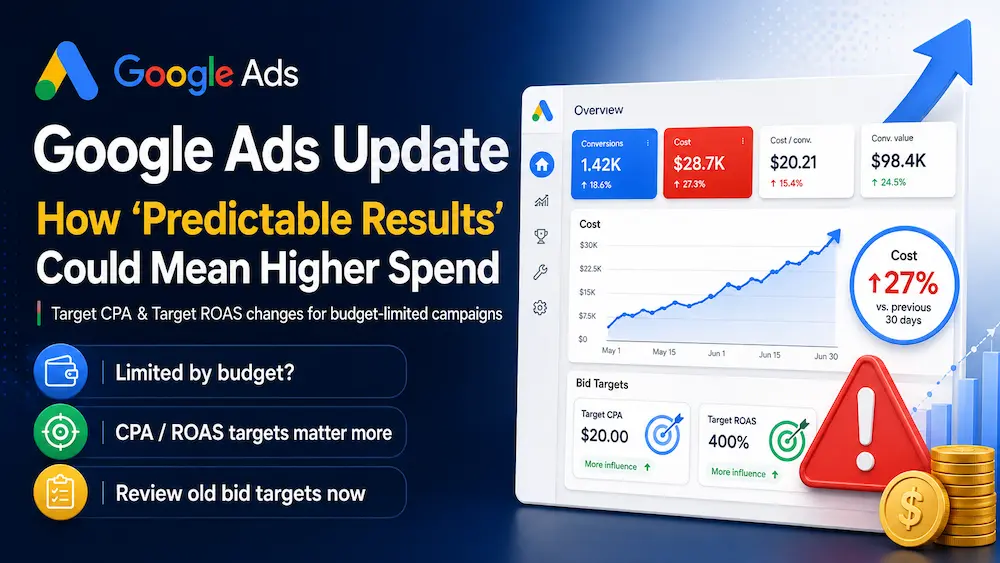
Google has changed how Target CPA (tCPA) and Target ROAS (tROAS) campaigns behave when they are limited by budget.
The update started rolling out on August 17, 2026.
Google describes the change as a way to make campaign performance more predictable when advertisers increase or adjust budgets.
But advertisers should also understand the other side of this update:
If your current CPA is much better than your Target CPA, Google may now have more freedom to spend aggressively and move your actual CPA closer to the target you entered.
In simple terms, if your campaign is getting leads for $50 while your Target CPA is $100, Google may interpret that $100 target as permission to pay significantly more for additional conversions.
That could mean more conversions, but also more spend and potentially lower profitability.
Read Google’s official announcement
What Exactly Changed in Google Ads?
Previously, campaigns that were Limited by budget could sometimes perform much better than the Target CPA or Target ROAS entered in the campaign.
For example:
- Target CPA: $100
- Actual CPA: $55
- Campaign status: Limited by budget
Even though the advertiser told Google they were willing to pay around $100 per conversion, the budget limitation could keep the campaign operating closer to the $55 CPA.
With Google’s new bidding behavior, the system will try to follow the advertiser’s CPA or ROAS target more consistently, even when the campaign is budget constrained.
This makes your bidding target much more important.
Example 1: Target CPA Campaign
Imagine a lead generation campaign with:
- Daily budget: $300
- Target CPA: $100
- Actual CPA: $60
- Status: Limited by budget
The advertiser may be happy because leads are currently coming in at $60.
But the campaign setting is effectively telling Google:
“I’m willing to pay around $100 per lead.”
Under the new behavior, Google may enter more expensive auctions to generate additional conversions.
Your CPA could potentially move from:
$60 → $70 → $85 → closer to $100
You may get more leads, but your cost per lead may also increase significantly.
This is why advertisers should not treat Target CPA as a random upper limit. It should reflect what the business can actually afford.
Example 2: Ecommerce Target ROAS Campaign
Suppose an ecommerce campaign has:
- Target ROAS: 300%
- Actual ROAS: 500%
- Daily budget: $1,000
- Status: Limited by budget
At 500% ROAS, the business generates roughly $5 in revenue for every $1 spent.
But a 300% Target ROAS tells Google that the advertiser is willing to accept approximately $3 in revenue for every $1 spent.
Google may now expand into additional auctions and increase spend while allowing ROAS to move closer to the 300% target.
Performance could move from:
500% ROAS → 420% → 350% → closer to 300%
Sales may increase, but profitability may not.
That is the key difference advertisers need to understand.
Why Is Google Making This Change?
Google says the goal is to provide more predictable bidding behavior when budgets change.
Google wants advertisers to control two things more clearly:
- Budget: How much you are willing to spend
- Target CPA / Target ROAS: The level of efficiency you are willing to accept
From Google’s perspective, this can make Smart Bidding more predictable.
From an advertiser’s perspective, it also means Google may have more room to consume your budget if your bidding targets are too loose.
Which Google Ads Campaigns Are Affected?
The update mainly matters for campaigns using target-based Smart Bidding that are Limited by budget.
This can include:
- Target CPA campaigns
- Target ROAS campaigns
- Eligible Target CPC Demand Gen campaigns
It can affect campaign types including:
- Google Search Ads
- Performance Max
- Shopping campaigns
- Demand Gen
- Travel campaigns
Campaigns that are not budget constrained already generally optimize toward their bidding targets, so the impact may be less noticeable.
The Biggest Risk: Old Targets You Forgot About
This could be one of the biggest problems for advertisers.
Many advertisers set a Target CPA or Target ROAS months ago and then forget about it.
For example:
- Target CPA: $150
- Current CPA: $80
- Maximum profitable CPA: $90
If the Target CPA remains at $150, Google may have much more flexibility to scale toward that number.
But the business may never have intended to actually pay $150 for a lead.
The old setting was simply never updated.
What Should Google Ads Advertisers Do Now?
There is no need to panic or immediately change every Google Ads campaign.
Instead, perform a quick bidding audit.
Pay special attention to campaigns where:
- Target CPA is much higher than actual CPA
- Target ROAS is much lower than actual ROAS
- The campaign shows Limited by budget
- The budget has recently been increased
- Performance Max is spending aggressively
- Profitability depends on maintaining a strict CPA or ROAS
Then ask one important question:
If Google actually achieves the bidding target I entered, would I still be happy with the campaign?
If the answer is no, your Target CPA or Target ROAS probably needs attention.
Don’t Blindly Accept Google’s Recommended Target
Google may provide bidding recommendations or tools to help advertisers adjust campaign targets.
These recommendations can be useful, but they should not replace business judgment.
Google understands:
- Clicks
- Conversions
- Conversion value
- Auction data
- Historical Google Ads performance
But Google may not fully understand:
- Your profit margin
- Lead quality
- Sales close rate
- Customer lifetime value
- Refunds or cancellations
- Offline revenue
- Operational costs
A $100 CPA may look acceptable inside Google Ads.
But if your business only makes money below a $70 CPA, $100 is not the right target.
Be Extra Careful With Performance Max
Performance Max advertisers should monitor this update closely because PMax can spend across multiple Google properties.
Monitor:
- Spend
- CPA
- ROAS
- Conversion volume
- Lead quality
- New customer acquisition
- Traffic quality
Don’t judge success only by whether Google reaches your Target CPA.
A campaign can technically achieve a $100 CPA and still generate poor-quality leads.
Should You Lower Your Target CPA Immediately?
Not necessarily.
Setting an unrealistically low Target CPA can also hurt campaign performance.
For example, if your campaign normally generates conversions at $80 CPA and you suddenly set the target to $35, Google may struggle to find enough eligible auctions.
This can result in:
- Lower impressions
- Reduced spend
- Fewer conversions
- Lower market coverage
The goal should be to find the right balance between:
Profitability + Conversion Volume + Growth
What This Google Ads Update Really Means
Google is making the relationship between budget and bidding targets much clearer.
Think of it this way:
- Budget: How much money Google can spend
- Target CPA / ROAS: How efficiently Google is allowed to spend it
If you tell Google:
“My Target CPA is $120,”
you should assume Google may actually optimize toward that level.
If you tell Google:
“My Target ROAS is 250%,”
you should be financially comfortable operating close to 250% ROAS.
Your bidding target should no longer be treated as a casual setting.
Final Takeaway
Google calls this update a way to deliver more predictable results.
But predictable results can also mean more predictable spending toward the targets you have entered.
If your Google Ads campaign currently performs much better than its Target CPA or Target ROAS, review the settings before Google’s bidding system starts using that extra room to scale.
Quick Google Ads Audit Checklist
- Find campaigns marked Limited by budget
- Compare Target CPA with actual CPA
- Compare Target ROAS with actual ROAS
- Check whether the current target is genuinely profitable
- Review old or forgotten bidding targets
- Monitor Performance Max campaigns closely
- Don’t blindly apply Google’s recommendations
- Avoid extreme bidding target changes overnight
The most important question is simple:
If Google spends according to the Target CPA or Target ROAS you’ve entered, will your business still make money?
If you’re not sure, now is a good time to review your Google Ads account.
Official Google Ads update: Google Ads Help – Changes to bidding for budget-constrained campaigns

Anil Singh is the Founder of Anirup Technologies LLP and a performance marketing strategist with over a decade of hands-on experience in Google Ads, PPC management, SEO and lead generation. He helps businesses build search-focused marketing systems that improve visibility, attract qualified leads and support measurable growth.
With strong expertise in Google Ads, Meta Ads, conversion tracking, landing pages and WordPress-based SEO, Anil focuses on practical strategies that connect marketing spend with real business outcomes. His work is especially focused on helping businesses use paid search and performance marketing with better structure, clearer reporting and stronger ROI accountability.