
If you’re running paid campaigns for a school, coaching center, or online course, you’ve probably asked yourself this question at least a dozen times: Should I put my budget into Google or Meta?
Both platforms promise student leads. Both have shiny dashboards and targeting options. But the reality? They work very differently. And picking the wrong one can burn through your ad spend faster than a teenager swipes through TikTok.
It’s not a silly question. Both platforms are powerful. Both can generate leads. But they work very differently, and spending your money on the wrong one can be a frustrating, expensive lesson.
Google Ads vs Meta Ads for Education: Understanding the Core Difference
Before comparing costs and features, you need to understand one fundamental thing, the intent behind each platform.
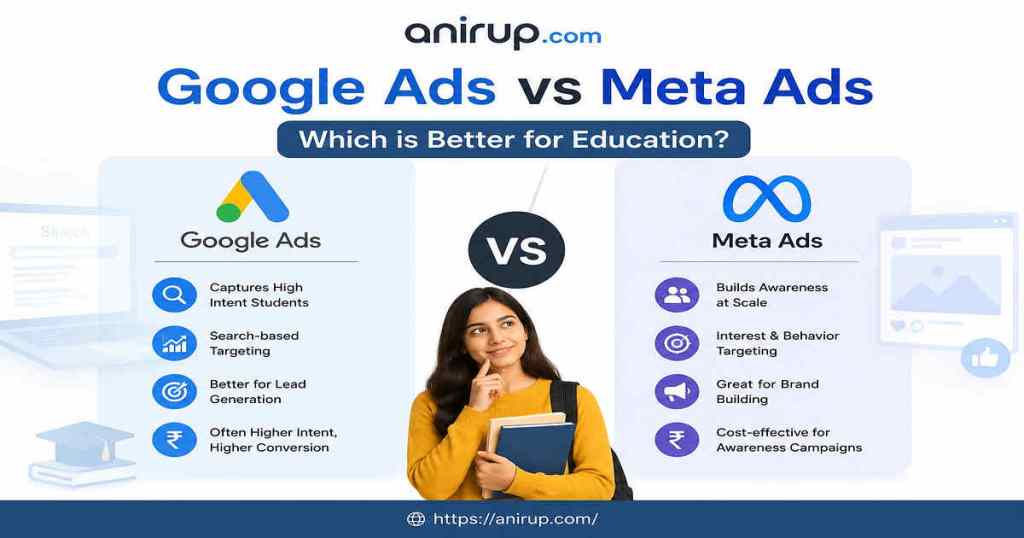
Google is a pull channel. Someone types “best MBA colleges in Delhi” or “digital marketing course online”, they’re already looking. They want answers. Your ad shows up at the right moment. That’s incredibly valuable in education, because a student actively searching for a course is a warm lead almost by definition.
Meta (Facebook and Instagram) is a push channel. You’re interrupting someone scrolling through reels or checking their friend’s photos. They weren’t thinking about your course a second ago. You have to stop them, spark interest, and then nurture them into a lead.
Neither approach is wrong. But they serve very different stages of the buyer journey, and that changes everything about how you use them.
Google Ads for Education: When It Works Best
Google Ads for education tends to work exceptionally well when there’s an established demand for what you’re offering. Think MBA programs, IELTS coaching, engineering entrance prep, coding bootcamps, courses people are already Googling.
With Search Ads, you bid on specific keywords and show up when someone is actively looking. The conversion rate is usually higher because the intent is already there. A student searching “best data science course in Bangalore” and clicking your ad is far more likely to fill a form than someone who just saw your Instagram post.
What makes Google Ads strong for education:
- High purchase intent, leads are warmer from the start
- Ability to target very specific searches (long-tail keywords work brilliantly here)
- Works well for courses with a defined admission cycle
- YouTube ads can also be layered in for video-based awareness
The downside? It can get expensive, especially for competitive categories. Cost-per-click for education keywords can run quite high, and if your landing page isn’t solid, you’ll burn through budget fast.
Meta Ads for Education: Where It Has the Edge
Meta Ads for education shine when you’re playing a longer game, building awareness, reaching people who don’t know they need your course yet, or retargeting website visitors who showed interest but didn’t convert.
Facebook and Instagram’s targeting is honestly impressive. You can reach people by age, location, interest, job title, income bracket, even life events like “recently graduated.” That kind of precision is hard to find anywhere else.
Facebook ads for education leads work particularly well for:
- New or niche courses that people aren’t actively searching for yet
- Retargeting campaigns (reaching people who visited your site but didn’t apply)
- Building brand familiarity over time
- Reaching parents alongside students
- Courses targeting working professionals (LinkedIn-style targeting, but cheaper)
The challenge is that leads from Meta tend to be cooler. They need more follow-up, more nurturing. Your admissions team has to do more work to close them. But the lead volume can be much higher, and the cost-per-lead is often lower, sometimes significantly so.
Google Ads vs Meta Ads for Education: A Direct Comparison
Here’s where things get practical. When it comes to education lead generation ads, the choice really depends on your specific situation.
- Cost per lead: Meta usually wins here. You can generate leads more cheaply, especially if your targeting is sharp. But quality matters, a Rs. 150 lead that never picks up the phone isn’t better than a Rs. 600 lead that shows up for a demo.
- Lead quality: Google tends to win. The intent-based nature of search ads means people are genuinely interested when they click.
- Speed to results: Google can start generating leads almost immediately if your keywords and landing page are right. Meta takes more time to optimise and warm up.
- Brand building: Meta is far better here. Visual storytelling, video content, carousel ads, Instagram especially is a great place to build recognition.
- Scalability: Both scale, but Meta is often easier to scale quickly once you’ve found a winning ad set.
The honest answer? For most education businesses, using both platforms together, with different roles, delivers the best results. Google for capturing high-intent traffic. Meta for expanding reach and retargeting.
Paid Ads for Student Leads: What Most Institutions Get Wrong
A lot of schools and institutes make the same mistakes. They dump money into paid ads for student leads without a clear strategy, and then blame the platform when results are disappointing.
Here are a few things that actually move the needle:
Landing pages matter more than the ads. You can have a brilliant ad and a terrible landing page, and you’ll still get nothing. The page needs to be fast, clear, and focused on one action, filling out the form.
Follow-up speed is everything. Studies consistently show that responding to a lead within five minutes dramatically increases conversion rates. If your team takes two days to call back, you’ve already lost most of those leads to a competitor.
Don’t neglect retargeting. Most students don’t convert on the first visit. Setting up retargeting campaigns on Meta to re-engage people who visited your site but didn’t apply is one of the highest-ROI things you can do.
Why Work With Anirup Technologies for Your Education Ads?
Running paid ads effectively, especially in the competitive education space, isn’t something you want to figure out through trial and error. Every mistake costs money.
Anirup Technologies specialises in performance marketing for education brands. From campaign strategy and keyword research to landing page optimisation and lead nurturing funnels, the team understands what it takes to generate quality student inquiries at scale, not just clicks.
Whether you’re running a college, a coaching centre, or an edtech platform, Anirup brings platform expertise and education industry experience together to help you get real returns on your ad spend.
Quick FAQs
Q1. Is it more affordable to use Google Ads or Meta Ads for education campaigns? Costs per lead are lower in Meta than Google; however, Google provides higher intent leads. The better option will depend on your needs.
Q2. Should I launch Google Ads and Meta Ads for education campaigns simultaneously?
Of course. You should consider using Google Ads for intent-based leads and Meta Ads for awareness and reach.
Q3. How much money do I need for a campaign in education?
At least ₹15,000 – ₹25,000/month per each platform will be needed to acquire enough data to optimise properly. Any lower amount will not let you collect enough statistics.
Q4. How long does it take to see results from paid ads for student leads?
Google Ads can show results within a week if set up correctly. Meta Ads typically take 2–4 weeks of optimisation before performance stabilises.
Q5. Do Facebook ads for education leads actually work?
Yes, when done right. The key is precise audience targeting, a compelling offer, and fast follow-up. Without a strong admissions process on the back end, even great leads will go cold.

Anirup is a performance marketing specialist and the publishing author behind Anirup.com, known for sharing practical, data-driven insights on Google Ads, PPC, and SEO. With a strong focus on building high-converting campaigns, Anirup specializes in lead generation strategies, keyword targeting, and conversion optimization. Backed by real campaign experience and a results-first approach, the content published under this profile is designed to help businesses, marketers, and advertisers scale efficiently through proven digital marketing strategies.