
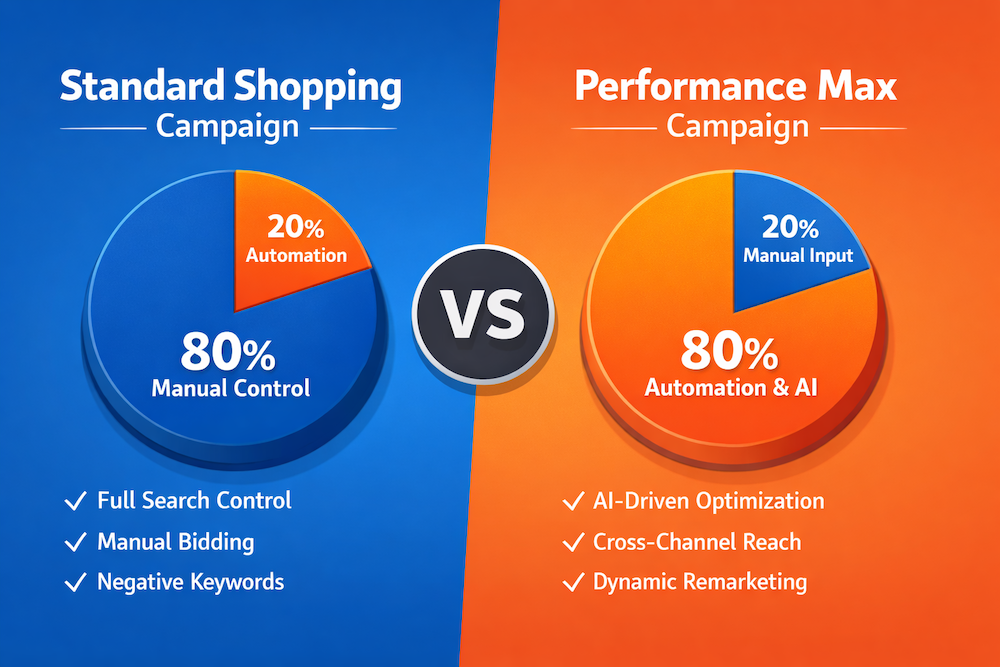
Performance Max vs Standard Shopping
Which Is Better for Your eCommerce Store in 2026?
In the ever-evolving Google Ads ecosystem (yes, hello from 2026 👋), the debate between Performance Max (PMax) and Standard Shopping is no longer about which one is better.
👉 The real question is:
Which one fits your eCommerce business right now?
Think of it this way:
- Standard Shopping is a manual-shift sports car — precise, controlled, and responsive to every move you make.
- Performance Max is a self-driving Tesla — powerful, fast, and designed to get results by using Google’s full ecosystem… whether you see the turns or not.
Both can make you money.
Both can also burn your budget — if used at the wrong time.
This guide will help you choose the right engine, for the right stage, with the right expectations.

1. Performance Max vs Standard Shopping – The Clear Breakdown
| Feature | Standard Shopping | Performance Max (PMax) |
|---|---|---|
| Ad Placements | Google Search & Shopping tab only | Search, Shopping, YouTube, Display, Gmail, Discover |
| Control Level | High – bids, negatives, devices | Low – AI-led, signal-based |
| Creatives Needed | Product feed only | Headlines, images, videos, descriptions |
| Data Transparency | Full search term & product data | Limited “Insights” (still a black box) |
| Best Use Case | ROAS control, testing, brand protection | Scaling, discovery, remarketing |
| Learning Curve | Low | Medium to High |
Key takeaway:
👉 Standard Shopping gives clarity.
👉 Performance Max gives reach.
2. Purpose: When to Use Which Campaign
✅ Use Standard Shopping when:
- Your budget is tight
If you’re spending under ~$3,000/month, PMax’s learning phase can waste budget quickly. - You want clean data
You want to see exact search terms to improve SEO, Search Ads, or product titles. - Some products need special care
Low-volume, high-margin, or “zombie” products perform better with manual control. - You don’t have creatives yet
No videos? No lifestyle images? Standard Shopping works fine with just a good feed.
Best mindset:
🎯 Control first. Learn fast. Protect margins.
🚀 Use Performance Max when:
- You want to scale beyond search
PMax unlocks YouTube, Discover, Gmail — places Shopping alone can’t reach. - You already have conversion data
Ideally 30–50+ conversions/month. AI needs signals to learn. - Remarketing matters
PMax automatically retargets visitors, cart abandoners, and past buyers. - You prefer automation over micromanagement
You guide the system instead of controlling every lever.
Best mindset:
📈 Scale volume. Expand reach. Let AI hunt opportunities.
3. Common Mistakes (Most Stores Lose Money Here)
❌ Performance Max mistakes
- The “Everything Bagel” mistake
Dumping all products into one PMax campaign → Google pushes only low-margin bestsellers. - No audience signals
No customer lists, no intent keywords = AI starts blind and expensive. - Unrealistic ROAS targets
Setting 500–600% ROAS on Day 1 kills impressions. Start flexible, then tighten. - Skipping videos
If you don’t upload a video, Google auto-creates a weak slideshow.
👉 Always upload at least one decent video.
❌ Standard Shopping mistakes
- No negative keywords
- Mixing high-margin and low-margin products
- One campaign for entire catalog
- No bidding logic at product or category level
- Expecting it to scale endlessly
4. How to Set Priority: The 2026 Hybrid Strategy
Earlier, Performance Max used to override everything.
That’s no longer the case.
As of late 2024–2025, Ad Rank wins the auction, not campaign type.
This enables a Hybrid Strategy — the most profitable setup for mature eCommerce stores.
🔹 Step 1: Standard Shopping = The Scalpel
- Run hero products
- Protect brand searches
- Use lower ROAS targets for stronger Ad Rank
- Maintain strict control on margins
🔹 Step 2: Performance Max = The Muscle
- Cover the rest of the catalog
- Focus on discovery + remarketing
- Slightly higher ROAS target
- Let it scale outside pure search intent
🔹 Step 3: Use exclusions smartly
- If a product must stay in Shopping → exclude it from PMax
- PMax does not respect Low/Medium/High priority like Shopping campaigns do
5. So… Which One Is Better?
There is no universal winner.
The winner depends on:
- Store maturity
- Monthly ad spend
- Conversion history
- Profit margins
- Growth vs profitability goals
Expert rule of thumb:
- 🟢 New store → Start with Standard Shopping
- 🔵 Growing store → Add Performance Max
- 🟣 Scaling brand → Run both with intent
Final Thought
Standard Shopping teaches you what works.
Performance Max helps you scale what already works.
Smart eCommerce brands don’t choose one.
They graduate from control to automation — deliberately.
- Recommend ROAS targets by product margin
- Create a Performance Max asset checklist
- Turn this into a lead-magnet or landing page
Frequently Asked Questions (FAQ)
1. Is Performance Max better than Standard Shopping?
No campaign type is universally “better.”
Standard Shopping is better for control, testing, and clean ROAS, while Performance Max is better for scaling and reaching new customers. The right choice depends on your store size, budget, and available data.
2. Can I run Performance Max and Standard Shopping together?
Yes — and in 2026, this is actually the recommended approach for most eCommerce stores.
Use:
- Standard Shopping for hero products and brand control
- Performance Max for discovery, remarketing, and scale
Just make sure to exclude overlapping products where needed.
3. How much budget do I need for Performance Max?
Ideally, you should have:
- At least 30–50 conversions per month
- A minimum monthly spend of ₹1.5–2 lakh ($2,000–3,000)
With lower budgets, Performance Max may struggle during its learning phase and waste spend.
4. Is Performance Max good for new eCommerce stores?
Generally, no.
New stores usually lack:
- Conversion history
- Audience data
- Creative assets
For new stores, Standard Shopping + Search Ads is a safer and more profitable starting point.
5. Why does Performance Max feel like a “black box”?
Performance Max limits visibility into:
- Search terms
- Placement-level performance
- Exact audience behavior
Google provides Insights reports, but you must trust the system more than with Standard Shopping. This trade-off exists because PMax optimizes across multiple networks at once.
6. Do I need videos for Performance Max campaigns?
Yes — and this is critical.
If you don’t upload videos:
- Google auto-generates basic slideshow videos
- These usually perform poorly
Even a simple 15–30 second product or brand video performs better than auto-created assets.
7. Which campaign gives better ROAS?
In most cases:
- Standard Shopping gives better short-term ROAS
- Performance Max gives higher total revenue and scale
This is why many profitable stores use Standard Shopping for profit control and Performance Max for growth.
8. Does Performance Max replace Shopping campaigns?
No. Performance Max does not replace Standard Shopping.
Think of it as:
- Shopping = Precision tool
- PMax = Expansion tool
Using both together delivers the best long-term results.
9. How long does Performance Max take to show results?
Performance Max typically needs:
- 2–4 weeks learning phase
- Stable tracking and conversion volume
Avoid making major changes during this period, especially to budget or ROAS targets.
10. What is the biggest mistake advertisers make with Performance Max?
The biggest mistake is launching Performance Max too early and expecting instant results.
Other common mistakes:
- No audience signals
- Unrealistic ROAS targets
- Poor creatives
- One campaign for all products
11. Should I set Target ROAS from day one?
For:
- Standard Shopping → Yes, you can start with ROAS
- Performance Max → Start with a reasonable ROAS, then tighten after data accumulates
Setting ROAS too high initially can stop delivery completely.
12. Which campaign should I start with?
Simple rule:
- New or low-budget store → Standard Shopping
- Established store with data → Performance Max
- Growing brand → Hybrid (both together)

Anil Singh is the Founder of Anirup Technologies LLP and a performance marketing strategist with over a decade of hands-on experience in Google Ads, PPC management, SEO and lead generation. He helps businesses build search-focused marketing systems that improve visibility, attract qualified leads and support measurable growth.
With strong expertise in Google Ads, Meta Ads, conversion tracking, landing pages and WordPress-based SEO, Anil focuses on practical strategies that connect marketing spend with real business outcomes. His work is especially focused on helping businesses use paid search and performance marketing with better structure, clearer reporting and stronger ROI accountability.