
Let me be honest, when most people set up a Google Ads campaign, they spend all their energy on bidding strategies and budgets. The actual ad copy? It gets maybe 20 minutes of rushed attention. And that’s exactly where a lot of money goes down the drain.
Someone builds a technically solid campaign, picks decent keywords, sets a reasonable budget, and then the results are just… flat. Average CTR, high CPC, mediocre quality scores. The problem wasn’t the targeting. It was the copy.
So let’s talk about a proper Google ads copy formula, not some generic checklist you’ve read a hundred times, but the actual stuff that makes a difference.
Understanding the Google Ads Copy Formula: What Are You Even Working With?
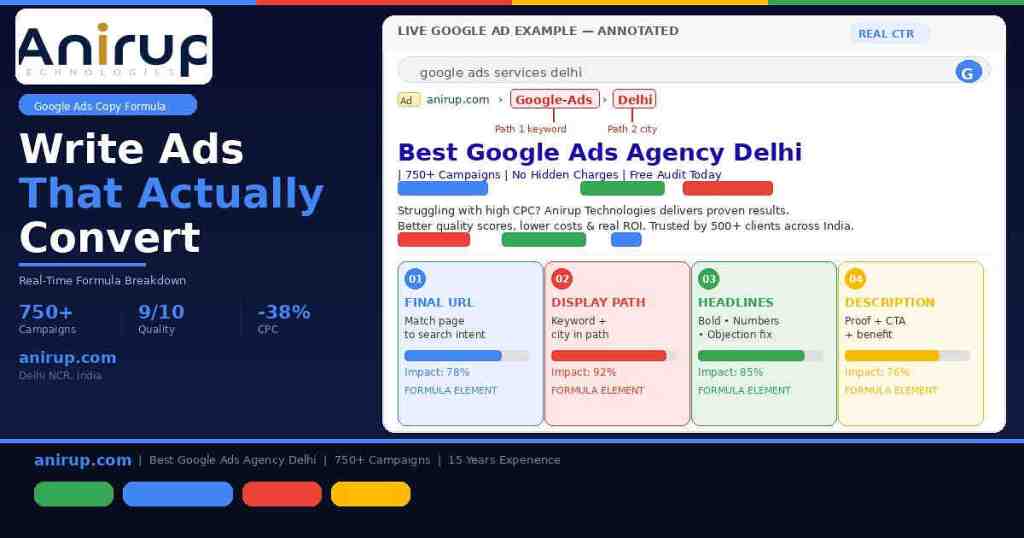
Before writing a single word, you need to understand what assets you’re actually filling in. Google’s responsive search ads give you several fields to work with:
- Final URL: where the user lands after clicking
- Display Path (Path 1 and Path 2): the visible URL shown in the ad
- Headlines: up to 15, shown in combinations of 3
- Descriptions: up to 4, shown in combinations of 2
Most guides jump straight to headlines. But here’s what’s interesting, the display path is where a surprisingly large number of advertisers leave free CTR on the table.
The Google Ads Copy Formula Starts With Your Final URL
This sounds boring, and honestly, it kind of is, but it matters more than people think. Your final URL should take the user to a page that directly matches what they searched for.
If someone searches “Google Ads management in Delhi” and your ad shows up, clicking it takes them to your general homepage with no mention of Google Ads or Delhi, you’ve already lost them. They’ll bounce. Your quality score takes a hit. And your CPC goes up because Google sees your landing page as irrelevant to the search query.
Match the intent. If your ad group is targeting keywords around a specific service or location, create a dedicated landing page for that. It doesn’t have to be fancy, it just has to be relevant. That’s the foundation of any good Google ads copy formula.
The Most Underused Google Ads Copy Formula Element
Okay, this is the part that genuinely surprises people when they hear it. The display path, specifically Path 1 and Path 2, shows up right below your domain name in the ad. Most advertisers either leave it blank or put something forgettable there.
Here’s the thing: users read the URL when they’re deciding whether to click. It’s a trust signal. And it’s also keyword real estate that most of your competitors are wasting.
Let’s say your website is something like “hap.com.” Just looking at that, no one has any idea what the business does. But in your display path, you can write:
hap.com/Google-Ads/Delhi
Now the person searching for Google Ads services in Delhi sees a URL that feels like it was built specifically for them. It’s personal. It’s specific. And it quietly communicates, “yes, we’re exactly what you’re looking for.”
The result? Better CTR. Higher quality score. Lower CPC. All three improvements, from one simple change that takes about 30 seconds to implement.
This is a core part of the Google ads copy formula because it costs nothing extra, it’s just a smarter use of space you already have.
Use of Display Paths in Google Ads Copywriting
Here’s something that a lot of experienced advertisers know but don’t talk about much. Certain branded terms, competitor names, or trademarked words can’t be used in your headlines because Google flags them for copyright or policy reasons. Your ad gets disapproved, you get frustrated, the campaign gets delayed.
But those same words? They often slip through fine in the display path. Not always, but often enough that it’s worth trying. If you’ve been blocked from using a specific term in your headlines and it keeps getting rejected, try putting it in Path 1 or Path 2 instead. You might be surprised.
This isn’t a hack or a workaround in any shady sense, it’s just understanding how the system works and using it intelligently.
How Google Ads Copy Formula for the Main Event?
Headlines are where your creativity matters most. Google can show up to 3 headlines at a time, pulling from the 15 you’ve written. Here’s how to approach them without wasting those slots:
- Lead with the keyword. If someone searches “affordable SEO services,” your first headline should probably include that exact phrase or something very close. Google bolds matching keywords in ads, which draws the eye.
- Use numbers and specifics. “Increase Sales by 30%” is more compelling than “Grow Your Business.” Vague promises don’t work as well as specific ones. People can smell generic copies.
- Address an objection or fear. If your audience worries about price, put “No Hidden Charges” in a headline. If they’re cautious about quality, try “Certified Experts” or “Trusted by 500+ Clients.” These aren’t just fluff, they reduce hesitation at the moment someone is deciding whether to click.
- Don’t repeat yourself. It sounds obvious, but a lot of advertisers write 15 variations of basically the same headline. Google mixes and matches, if your headlines all say the same thing, you’re wasting the variety. Make each one bring something different.
How This All Connects you with Google Ads Optimization Through Copy
Here’s the bigger picture. Every element of your Google ads ad text examples, the URL, the display path, the headlines, the descriptions, contributes to your Quality Score. And Quality Score directly affects how much you pay per click and where your ad shows up.
A high Quality Score means:
- Lower CPC (Google rewards relevance)
- Better ad positions
- More impressions for the same budget
Most advertisers try to improve performance by adjusting bids or changing targeting. Those matter, but if your copy is weak, you’re fighting an uphill battle. Fix the copy first.
Need Someone to Handle This for You?
Understanding the Google ads copy formula is one thing. Executing it consistently across multiple campaigns, ad groups, and accounts while also managing bids, tracking conversions, and analyzing performance, that’s a full-time job on its own.
That’s exactly where Anirup Technologies comes in.
Based in Delhi with over 15 years of experience in PPC advertising, Anirup Technologies is one of India’s most trusted Google Ads agencies. They’ve managed 750+ projects across industries, from travel and real estate to education, healthcare, and e-commerce. Their team doesn’t just run ads; they build strategies that are designed to actually deliver, better leads, lower cost per conversion, and measurable growth.
FAQs
Q1. What is the Google ads copy formula in simple terms?
It’s the structured approach to writing each element of your ad, final URL, display paths, headlines, and descriptions, in a way that’s relevant, specific, and compelling to your target audience.
Q2. Why does the display path matter for CTR improvement?
Google ads CTR improvement adds keyword context and location-specific information to your ad URL, making it feel more relevant to the user, which increases the likelihood they’ll click.
Q3. How many headlines should I write for a responsive search ad?
You can write up to 15. It’s worth writing all 15 with real variety, Google’s machine learning will test combinations and favor the ones that perform best.
Q4. Can I use trademarked words in Google Ads?
Generally not in headlines, as they often get disapproved. However, display path fields are sometimes more lenient, worth testing if you’re facing repeated rejections.
Q5. What’s the fastest way to improve Google Ads performance through copy?
Start with your display paths (most people ignore them), then audit your headlines for keyword relevance and specificity. Small copy changes can produce noticeable improvements in CTR and quality scores within days.

Anirup is a performance marketing specialist and the publishing author behind Anirup.com, known for sharing practical, data-driven insights on Google Ads, PPC, and SEO. With a strong focus on building high-converting campaigns, Anirup specializes in lead generation strategies, keyword targeting, and conversion optimization. Backed by real campaign experience and a results-first approach, the content published under this profile is designed to help businesses, marketers, and advertisers scale efficiently through proven digital marketing strategies.