
Choosing an ecommerce platform feels exciting at first. You open a few comparison articles, watch some YouTube videos, maybe join a Reddit thread, and two hours later you’re more confused than when you started.
Everyone has an opinion. Everyone says their platform is the best. And half the “comparison” blogs out there are quietly sponsored by the platform they rank number one.
So here’s what we are going to walk you through the real differences between the top platforms, and help you figure out which one actually makes sense for your situation. No affiliate links. No fluff.
What Is an Ecommerce CMS & Why Does It Matter?
A CMS (Content Management System) is basically the software that runs your website behind the scenes. It lets you add products, update pages, manage orders, and run your store without touching a single line of code. When it’s built specifically for selling online, we call it an ecommerce CMS or an ecommerce platform.
Think of it as the engine under the bonnet of your online store. Your customers never see it, but everything, how fast your pages load, how easy checkout is, how well you rank on Google, depends on it.
Here’s what a good ecommerce CMS actually does for your business:
- Manages your products and inventory in one place, without spreadsheets
- Handles payments securely so you don’t have to build payment systems yourself
- Keeps your store SEO-ready so customers can find you on Google
- Scales with you as your orders go from 10 a day to 10,000
- Connects to your other tools, email marketing, analytics, shipping, CRM
Some popular examples you’ve probably heard of: Shopify, WooCommerce, Magento, BigCommerce, and Wix. Each one is an online store builder with its own strengths, pricing, and ideal use case. The trick is matching the right one to your business, not just picking the most popular one.
Where the Top Ecommerce Platforms Stand Right Now
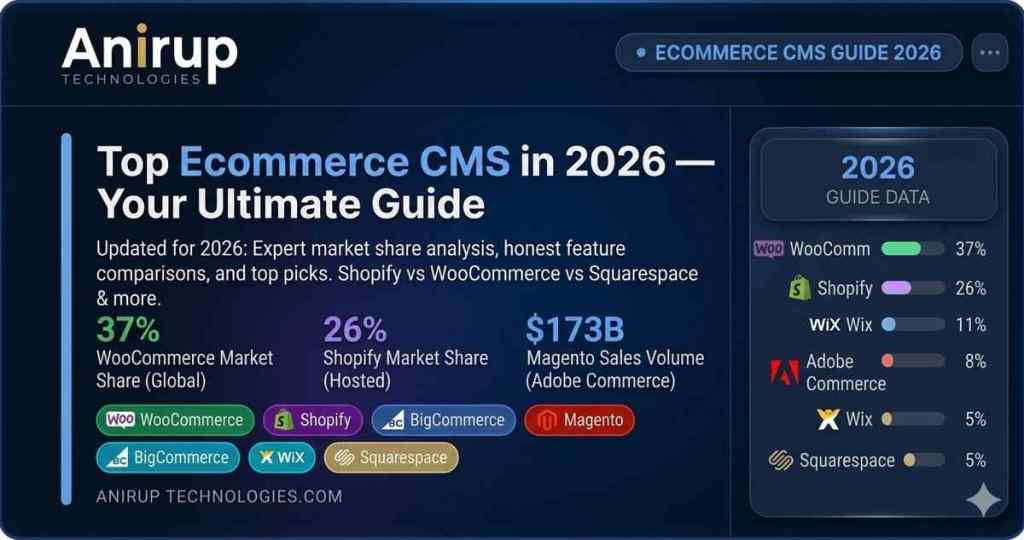
Before we talk about which is best, here’s the honest market picture in 2026:
| Platform | Market Share 2026 | Best Fit |
| WooCommerce | ~37% | Flexibility lovers, WordPress users |
| Shopify | ~26% | Fast launchers, growing brands |
| Wix | ~8–14% | Beginners, tiny catalogs |
| Adobe Commerce | ~8% | Large enterprises |
| Squarespace | ~5–9% | Design-focused, small stores |
| BigCommerce | ~5% | Mid-size, complex catalogs |
WooCommerce has the most stores. Shopify has the most revenue per store. That gap tells you something important, WooCommerce wins on volume but Shopify tends to attract bigger, faster-growing businesses. Neither is objectively better. They’re just built for different people.
The Best Ecommerce Platform 2026 & Honest Takes on Each One
Shopify
I’ll be honest, Shopify has earned its reputation. It’s genuinely good at what it does. You sign up, pick a theme, connect your products, and you’re selling within a day. No server management, no plugin conflicts, no hosting headaches.
- In 2026 they’ve pushed hard on AI. Shopify Magic now writes your product descriptions, fixes your product photos automatically, and helps predict when you’ll run low on stock.
- The checkout is also one of the best conversions on the internet, their Shop Pay feature reportedly lifts conversion by up to 50% compared to a standard checkout.
- Where Shopify gets tricky is cost. The base plan is fine, but the moment you need specific features you start adding apps, and those apps charge monthly fees.
- It’s easy to end up paying ₹15,000–₹25,000 a month just in app subscriptions on top of your plan fee.
If you want to start selling fast and don’t want to deal with technical stuff, it’s the best ecommerce cms for you. Just watch your app costs.
WooCommerce
WooCommerce is free. The core plugin costs nothing. You install it on your WordPress site and you have a store. That alone is why it powers 37% of all online stores worldwide.
- But free doesn’t mean cheap. You still need hosting, you still need security plugins, you still need a developer occasionally when something breaks. The real cost isn’t the software, it’s the time and technical overhead.
- What WooCommerce gives you in return is complete freedom. You own your data. You can customize literally anything. You’re not locked into any company’s ecosystem.
- For businesses that care deeply about SEO, content marketing, or running complex custom setups, it’s genuinely the best CMS for ecommerce website projects.
Great if you have some technical support or are comfortable with WordPress. Not great if you want something hands-off.
Adobe Commerce (Magento)
This one isn’t for most people reading this. Adobe Commerce is enterprise software. It powers massive retail operations, the kind of businesses managing hundreds of product variations, selling in multiple countries, running both B2B and B2C operations from one backend.
- The numbers show it processes over $173 billion in annual sales volume. It holds about 8% market share, but that 8% includes some of the largest retailers in the world.
- If you’re running a serious enterprise operation and need a platform with no ceiling, this is it. If you’re a growing mid-size business, it’s probably overkill, and the implementation costs will eat your lunch.
Powerful, expensive, and built for big businesses. Skip it unless you’re ready for a serious investment.
BigCommerce
BigCommerce doesn’t get talked about as much as Shopify but it deserves more credit. It sits at around 5% market share and targets mid-market businesses.
- The ones who’ve outgrown Shopify’s basic plans but don’t need something as heavy as Magento.
- The big practical advantage is that BigCommerce has a lot built in natively. Shopify often needs apps for things that BigCommerce includes out of the box, which means lower total monthly costs as you scale.
- It also handles complex product catalogs and B2B selling better than Shopify does.
Worth a serious look if you’re in the ₹5–50 crore revenue range and feeling constrained by Shopify.
Wix
A few years ago we would have told you to avoid Wix for ecommerce entirely. In 2026 that advice needs updating, Wix has genuinely improved.
- It holds somewhere between 8–14% of the CMS market and has been quietly adding ecommerce features that actually work.
- That said, it still has limits. It’s fine for small stores with simple needs. The moment your catalog gets large, your operations get complex, or you need serious SEO control, you’ll feel those limits clearly.
Fine for starting small. Build your business on it, not your long-term growth strategy.
Ecommerce CMS Comparison: Which One Is Actually for You?
Here’s the most useful thing, we can give you, a plain-language guide to which ecommerce platform is best based on your actual situation:
| Your Situation | Go With |
| First store, no tech knowledge | Shopify |
| Already on WordPress, want flexibility | WooCommerce |
| Growing fast, outgrowing Shopify | BigCommerce |
| Enterprise with complex operations | Adobe Commerce |
| Tiny store, simple products | Wix or Squarespace |
| Content + Commerce together | WooCommerce |
Three 2026 Trends That Should Influence Your Decision
- AI is now core, not extra. Every major platform is baking AI into the product, writing tools, image editing, inventory prediction, personalized recommendations. Before you commit to a platform, ask yourself: does it have real AI features built in, or is it still bolting them on through third-party apps?
- Mobile checkout is where stores live or die. Mobile shopping abandonment is sitting at around 85% in 2026. That means 85 out of 100 people who start a purchase on mobile don’t finish it. The platform you choose needs frictionless, fast mobile checkout, not an afterthought.
- Headless is getting real. More serious ecommerce businesses are going headless, separating the frontend of their store from the backend. It gives you more speed, more flexibility, and more control over how your content appears across different channels.
The headless CMS market is growing fast and will be worth over $22 billion by 2034. If you’re planning to scale seriously, it’s worth understanding this direction now.
So, Which Ecommerce Platform Is Best in 2026?
There’s no single right answer, and if someone tells you there is, they’re probably getting a commission.
The best ecommerce CMS is the one that matches where you are today and gives you room to grow into tomorrow. For most small and mid-size businesses starting out in India, that’s usually Shopify for speed or WooCommerce for flexibility. For bigger operations, the conversation gets more specific.
At Anirup Technologies, we work with businesses across all of these platforms. We help you pick the right one, build it properly, and grow it without the usual growing pains. If you’re sitting on this decision and want a straight opinion from people who do this every day, just reach out. We’ll tell you exactly what we’d do in your position.
FAQs (Frequently Asked Questions)
Q1. Which is the best ecommerce CMS for beginners in 2026?
Shopify is the easiest starting point. No technical skills needed, quick setup, and everything is managed for you in one place.
Q2. Is WooCommerce really free to use?
The core plugin is free, but you’ll spend on hosting, security, and occasional developer help. Budget ₹3,000–₹8,000 monthly for running costs.
Q3. How do I choose between Shopify and WooCommerce?
Simple rule, want ease and speed, go Shopify. Want full control and flexibility over your store, go WooCommerce. Both are solid choices in 2026.

Anirup is a performance marketing specialist and the publishing author behind Anirup.com, known for sharing practical, data-driven insights on Google Ads, PPC, and SEO. With a strong focus on building high-converting campaigns, Anirup specializes in lead generation strategies, keyword targeting, and conversion optimization. Backed by real campaign experience and a results-first approach, the content published under this profile is designed to help businesses, marketers, and advertisers scale efficiently through proven digital marketing strategies.